Why Should I Create a HealthMemory Account?
HealthMemory Editorial Team · · 8 min read
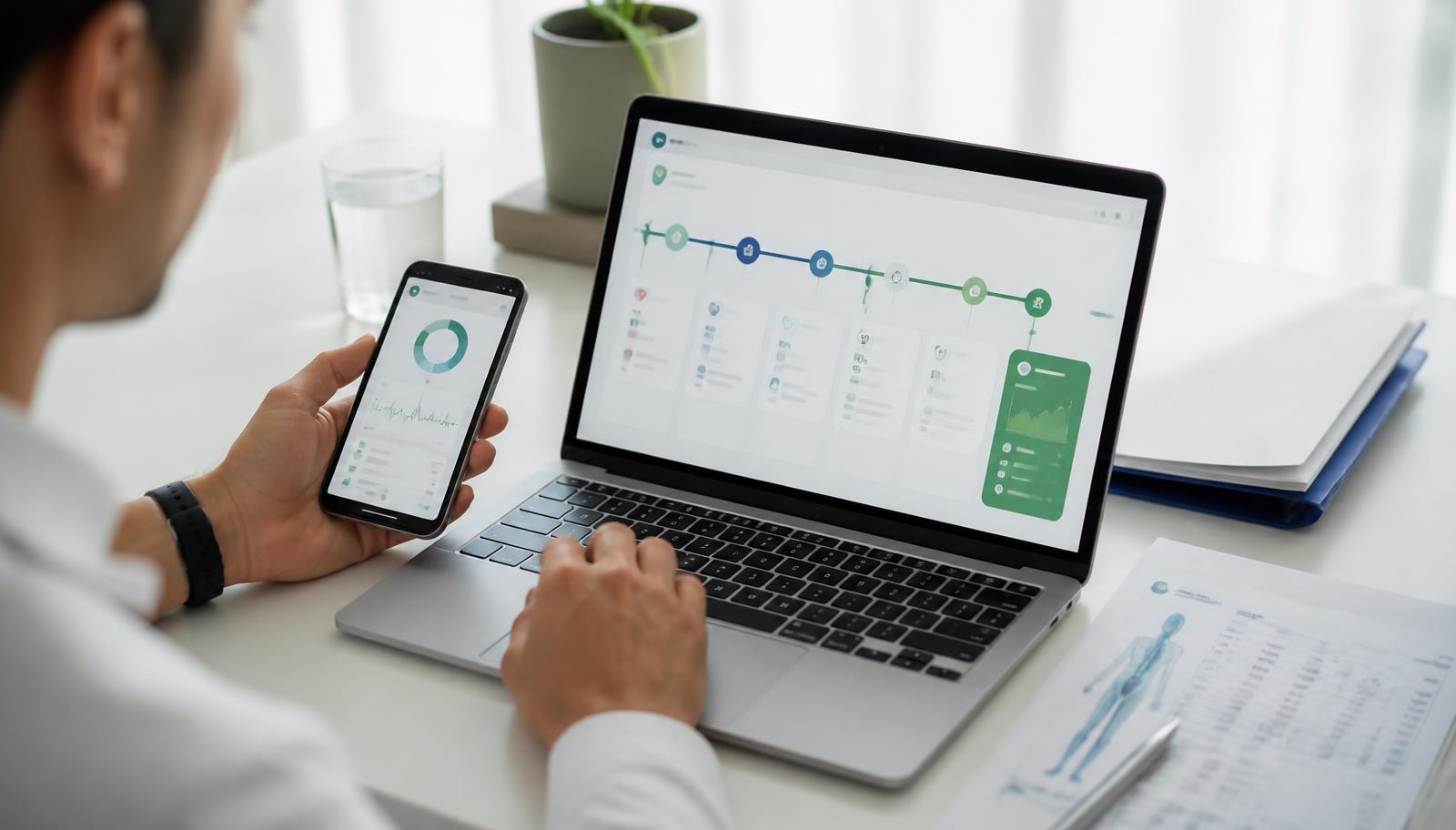
Most people don't lose their health history all at once. It leaks away slowly. The date of that first bad migraine lives in your memory. The prescription from last winter is a folded strip in a drawer. Lab reports sit as PDFs in your email, or as photos in a chat thread you sent to a relative. One specialist has part of the story, your family doctor has another part, and the hospital you visited while travelling has a third. Nobody — including you — has the whole picture.
Then you sit in front of a new doctor who asks a simple question: "When did this start, and what have you already tried?" And you guess.
A HealthMemory account exists for that moment. It is a place to keep your own organized health history, in your own words, so the details are still there months and years later.
What is a HealthMemory account?
A HealthMemory account is a personal health record you maintain yourself. You log symptoms as they happen, record medicines you start and stop, note doctor visits and what was said, and keep track of reports and events that matter. Everything lands on a single searchable timeline, ordered by date.
That definition isn't unique to us. The NCBI Bookshelf entry on the Personal Health Record describes a PHR as health information maintained by the individual or their caregiver — history, diagnoses, medications, interventions, immunizations and allergies. The distinguishing feature is who keeps it: you do.
It is worth being precise about what HealthMemory is not. It is a health-information organization and memory tool. It is not your provider's medical record, it is not a patient portal, it does not replace emergency care, and nothing in it is medical advice. It does not automatically pull data from hospitals or labs — what's in your timeline is what you or your caregiver put there.
Why create one if I already have a patient portal?
Patient portals are genuinely useful, and you should use yours. But a portal shows one organization's view of you. If you've seen doctors at more than one clinic, changed cities, or used a hospital while travelling, your history is split across several portals with no shared thread.
A portal also records what a clinician documented during a visit. It doesn't record the three weeks of intermittent symptoms that led you to book the appointment, the over-the-counter medicine that helped, or the fact that the same thing happened last September.
The US Office of the National Coordinator for Health IT makes the case for holding your own copy plainly. In Get It, Check It, Use It and Patient Access to Health Records, ONC describes how having your health record helps you understand and manage your care, advocate for yourself, share information more easily with the people treating you, and stay on top of tests and immunizations.
HealthMemory sits alongside a portal, not against it. The portal is the clinical source of truth. Your account is the continuous, personal narrative that connects the visits.
Where a personal timeline fits
| Where your history lives | Complete over years? | Searchable? | Covers multiple providers? | Includes your day-to-day symptoms? |
|---|---|---|---|---|
| Memory | Fades | No | Partly | Roughly |
| Paper files and prescriptions | If you keep everything | No | Yes, if filed | Rarely |
| Photos, email and chat threads | Scattered | Hard | Yes, in fragments | Sometimes |
| Patient portal | Within that organization | Usually | No | Usually not |
| HealthMemory account | As long as you keep adding | Yes | Yes | Yes |
Each of these has a real job. Portals are authoritative. Paper is durable. The gap is a single place where the whole story stays in order — and that's the gap an account fills.
Practical reasons to create a HealthMemory account
1. You build a long-term health history. Two years of small entries becomes something you can't reconstruct from memory: patterns, recurrences, and what actually changed.
2. Symptoms keep their dates. "Since around March" and "March 12, worse in the evenings, lasted nine days" are different quality answers, and only one of them helps a clinician.
3. Your medication history stays intact. Not just what you take today, but what you took, for how long, at what dose, who prescribed it, and why you stopped. If you want the full method, see how to keep track of your medications.
4. Doctor visits, diagnoses and treatments are recorded in your own words. What was suspected, what was ruled out, what was advised — captured while it's fresh instead of half-remembered later.
5. Reports and important events sit in the right place on the timeline. A lab result means much more when you can see the symptoms and medicines from the same weeks.
6. Everything is searchable. Search a symptom, a medicine name, or a doctor and get every related entry, instead of scrolling through a year of files.
7. Appointment preparation stops being a scramble. You arrive with dates, doses and history ready. Our guide on organizing your medical history before seeing a new doctor walks through exactly what to bring.
8. You rely less on memory under stress. Illness, pain and worry are the worst conditions for accurate recall — which is exactly when accurate recall is asked of you.
9. You have a reference for later, and for the people who help you. Caregivers, or a family member managing an older parent's care, don't have to reconstruct anything from scratch.
10. You notice things you'd otherwise miss. Seeing three similar episodes in one view is often what prompts the question worth asking your doctor.
What should you add first?
You don't need a complete archive to start. Fifteen minutes is enough for a useful foundation:
- Current medicines, with dose and roughly when you started each one.
- Known allergies and reactions, including which drug or food and what happened.
- Ongoing or recurring conditions you're managing.
- Your last two or three doctor visits — date, who you saw, and the outcome.
- Any recent test or lab report you already have a copy of.
- Major past events: surgeries, hospitalizations, significant injuries, with approximate years.
After that, the habit is small: add things as they happen. A new symptom takes thirty seconds to log. That's the whole discipline.
Who benefits most?
Almost anyone benefits from an organized history, but a few situations make it especially worthwhile:
- People managing a long-term condition, where the trend over months matters more than any single reading.
- Anyone seeing multiple specialists, where no single clinician holds the full picture.
- People who have moved cities or changed providers, and left records behind.
- Caregivers and parents, who track health details for someone other than themselves.
- People with recurring, hard-to-pin-down symptoms that never quite line up with an appointment date.
- Anyone who has walked out of a consultation and remembered the important detail in the car park.
If none of these describe you today, one of them probably will eventually. A history you started before you needed it is the only kind that's ready when you do.
How to get started
- Create your account. It takes a minute.
- Add your current medicines and known allergies. This is the highest-value ten minutes you'll spend.
- Log your last few visits with dates and outcomes.
- Add anything as it happens — symptoms, appointments, reports.
- Open your timeline before your next appointment and skim the last few months.
That's it. The value compounds quietly; six months in, you'll have something you couldn't have reconstructed by trying.
Frequently asked questions
Is HealthMemory a medical record from my hospital? No. It's your own personal health record, maintained by you. Your provider's records and patient portal remain the clinical source of truth, and you should keep using them.
Does HealthMemory import my reports automatically? No. You add your own entries and information. Nothing is pulled from hospitals, labs or insurers.
Can it replace a doctor's advice? No. It's an organization and memory tool. It helps you describe your history accurately; interpreting that history is a clinician's job. In an emergency, contact emergency services — don't consult an app.
How much time does this take? Setup is around fifteen minutes. After that, most entries take under a minute, added as things happen.
What if my history goes back years and I don't remember the details? Start with what you're sure about, and use approximate dates ("summer 2023") where you aren't. An imperfect record is far more useful than none, and it improves from the day you begin.
Is this only for people who are unwell? No. Immunizations, routine test results and occasional illnesses are worth keeping too — and it's easier to start a record when you're well than when you're not.
Start your health history today
The best time to begin a personal health record was at your last appointment. The second-best is now, while the details are still recoverable.
Create your free HealthMemory account and spend fifteen minutes on your current medicines, allergies and recent visits. The next time someone asks when it started and what you've already tried, you'll have the answer.
Related reading
- What is a personal health record (and why a patient portal isn't one)
- Why you should keep a personal health record — and why most people don't
- Why you should organize your medical history
- How to organize your medical history before seeing a new doctor
Sources
- Office of the National Coordinator for Health IT, Get It, Check It, Use It (accessed January 20, 2026): https://healthit.gov/get-it-check-it-use-it/
- Office of the National Coordinator for Health IT, Patient Access to Health Records (accessed January 14, 2026): https://healthit.gov/patient-access-to-health-records/individuals/
- NCBI Bookshelf, Personal Health Record (updated September 10, 2024): https://www.ncbi.nlm.nih.gov/books/NBK557757/
This article is for informational and educational purposes only and is not a substitute for professional medical advice, diagnosis, or treatment.
This article is for informational and educational purposes only and is not a substitute for professional medical advice, diagnosis, or treatment.
Your health history shouldn't be scattered across papers, prescriptions and WhatsApp messages. Start building your HealthMemory.
Create Your HealthMemoryRelated articles
Medical Records
How to Keep Track of Your Medications: A Simple System That Actually Works
Keeping track of medicines can become difficult when you have multiple prescriptions, supplements, or medications that change over time. Learn what to record, how to organize your medication history, and how HealthMemory can help.
Health Technology
Why You Should Keep a Personal Health Record — And Why Most People Don’t
Most people forget important details about their health history. Learn why keeping a simple personal health record and timeline can help you remember symptoms, medicines, doctor visits, and important health events.
Preventive Health
Monsoon Stomach Infections: How to Prevent Diarrhea and Food- or Water-Borne Illness
Monsoon rain can increase everyday exposure to unsafe food and water. Learn how to reduce the risk of diarrhea, recognize dehydration, and keep a useful health record when illness strikes.
Symptoms & Conditions
Dengue Symptoms: What to Watch for During Monsoon and When to Seek Medical Care
Dengue can begin like many other infections. Learn the common dengue symptoms, warning signs of severe dengue, prevention steps, and why tracking your health history matters.