Why You Should Keep a Personal Health Record — And Why Most People Don’t
HealthMemory · · 3 min read
We remember our birthdays, work meetings, and important documents.
But when was the last time you had a headache?
What symptoms did you have?
What medicine did you take?
Did it help?
When did you last visit a doctor?
For many people, these answers are difficult to remember.
Our health history is scattered across prescriptions, medical reports, WhatsApp messages, phone galleries, notebooks, and sometimes just our memory.
That can make it surprisingly difficult to understand our own health journey.
The Problem: Your Health History Is Easy to Forget
A doctor may ask:
“When did this problem start?”
You might remember approximately.
Then comes another question:
“What medicine did you take last time?”
You search through your phone.
And:
“Have you experienced this before?”
You try to remember.
This happens because we don't usually maintain a simple, organized record of everyday health events.
A single headache or fever may not seem important.
But after months or years, these small events can become useful pieces of your personal health history.
What Should You Keep Track Of?
A personal health record doesn't have to be complicated.
You can record things such as:
- Symptoms you experienced
- Headaches, fever, dizziness, stomach problems, etc.
- Medicines you took
- Doctor visits
- Medical reports
- Diagnoses
- Allergies
- Important health events
- Weight and other personal measurements
- Notes about how you felt
- Dates when something happened
The most important part is the date.
Knowing what happened and when it happened can help you build a clearer picture of your health over time.
Your Health Story Is More Than Medical Reports
Medical reports are important, but they don't capture everything.
A report might tell you your test results.
It doesn't necessarily tell you:
- When your symptoms first appeared
- How long they lasted
- What you tried
- Whether the same problem happened previously
- How you felt during that period
Your everyday experiences are part of your health history too.
That's why keeping a personal health timeline can be valuable.
Meet HealthMemory
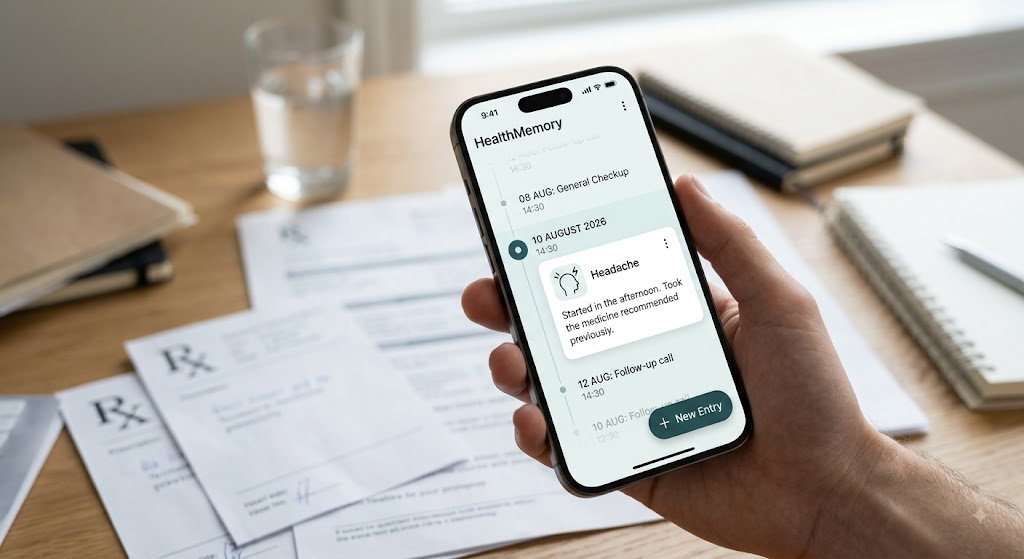
HealthMemory is designed to make remembering your health history simple.
Instead of keeping health information in different places, you can record important health events in one organized space.
Add a memory in seconds.
For example:
10 August 2026
Headache
“Started in the afternoon. Took the medicine recommended previously.”
Over time, these individual memories become a personal health timeline.
When you need to remember what happened months ago, you don't have to rely entirely on memory.
You can look it up.
Turn Small Memories Into a Health Timeline
Imagine looking back at your health history and seeing:
March — Headache April — Doctor visit May — Stomach problem July — Fever August — Headache
Patterns and history become much easier to review when information is organized chronologically.
This doesn't replace professional medical advice.
Instead, it helps you keep better records so that you can have more useful information when discussing your health with a healthcare professional.
Why Start Today?
You don't need to wait until you have a serious health problem.
Start with something simple.
Record:
What happened. When it happened. What you did. What you want to remember.
Even a small record today could become useful months or years from now.
Your future self may thank you for remembering what your present self would otherwise forget.
Your Health. Your Memories. Your Timeline.
We take hundreds of photos to remember important moments in our lives.
Our health deserves the same attention.
HealthMemory gives you a simple place to remember your health journey — one memory at a time.
Start recording today and build your personal health timeline.
HealthMemory — Your health history, remembered.
HealthMemory is a personal health-record and journaling tool. It is not a substitute for professional medical diagnosis or medical advice.
This article is for informational and educational purposes only and is not a substitute for professional medical advice, diagnosis, or treatment.
Your health history shouldn't be scattered across papers, prescriptions and WhatsApp messages. Start building your HealthMemory.
Create Your HealthMemoryRelated articles
Medical Records
Why Should I Create a HealthMemory Account?
Your health details are scattered across memory, prescriptions, PDFs and different providers. Here is what a HealthMemory account is, how it differs from a patient portal, and the practical reasons to keep your own organized health history.
Health & Wellness
Why You Should Organize Your Medical History
Your medical history can include years of symptoms, medications, diagnoses, doctor visits, tests, and health events. Learn why organizing this information can make it easier to remember, review, and share when you need it.
Medical Records
How to Keep Track of Your Medications: A Simple System That Actually Works
Keeping track of medicines can become difficult when you have multiple prescriptions, supplements, or medications that change over time. Learn what to record, how to organize your medication history, and how HealthMemory can help.
Medical Records
How to Organize Your Medical History Before Seeing a New Doctor
Seeing a new doctor? Learn what medical information to gather, how to organize your medications, allergies, reports, symptoms, and previous visits—and how a personal health timeline can make your next appointment easier.